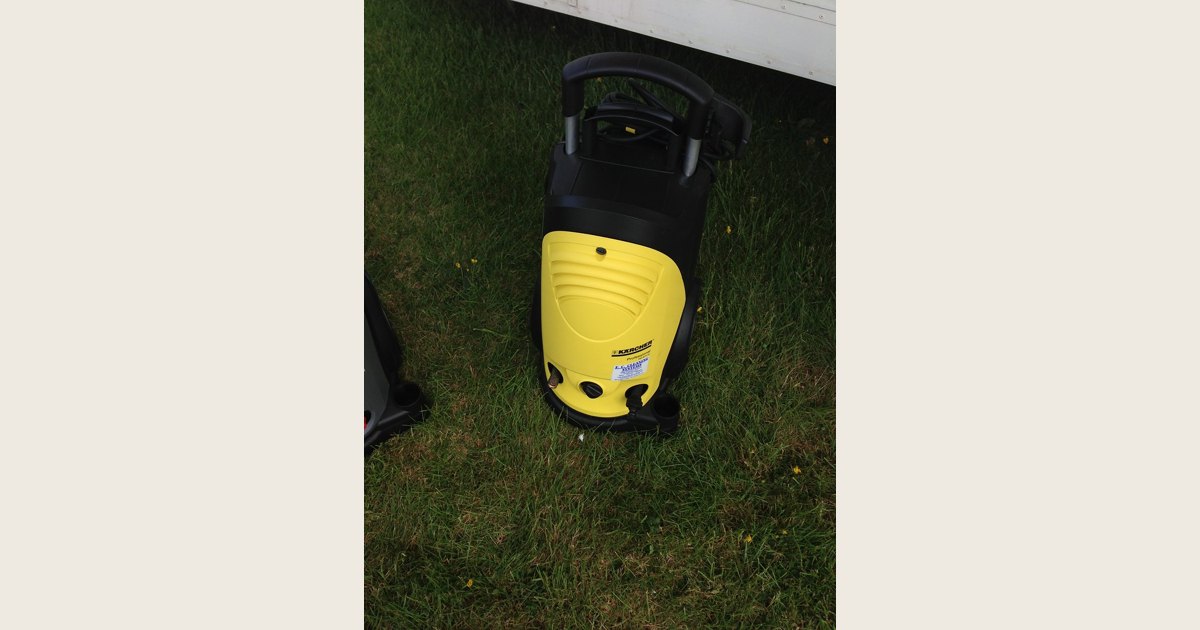
A pressure washer takes water from a supply hose, uses a motor or engine to drive a pump, and sends the resulting flow through a pressure hose, trigger gun, and nozzle. The pump moves water; the nozzle restricts and shapes its exit, helping create the pressure and concentrated spray that loosen grime. When you release the trigger, an unloader valve responds to the closed gun so the pump can unload rather than keep pushing against a blocked outlet. The parts work as one system, so pressure alone does not explain cleaning power: water flow, nozzle shape, and the surface all matter too.
Featured image: “Karcher pressure washer” by Kai Hendry, via Flickr, licensed under CC BY 2.0. Resized and padded. Illustrative stock photo; no product testing is implied.
Key Takeaways
- A motor or engine turns the pump, which moves water from the inlet toward the spray gun.
- The nozzle’s restriction helps create pressure and its opening determines the spray pattern.
- The trigger gun controls the outgoing stream; an unloader changes the pump’s operating state when the gun closes.
- PSI describes pressure, while GPM describes water flow. Both affect what the washer can do.
The water path, from hose to spray
Think of a pressure washer as a water path with a power source and a pressure-control branch:
Water supply → inlet → pump → high-pressure hose → trigger gun → nozzle → surface
The motor or engine drives the pump. On many systems, an unloader connects to the pressure side of the system and responds when the trigger gun closes. The exact internal layout differs by washer, but the main jobs are consistent: supply water, move it, control when it exits, and shape the spray.
| Part | What it does |
|---|---|
| Water inlet | Connects the washer to its water supply; some designs include an inlet screen or filter. |
| Motor or engine | Supplies the rotary power that drives the pump. |
| Pump | Moves water through the machine and into the pressure hose. |
| Unloader | Responds to pressure changes when the downstream gun shuts off. |
| Pressure hose and trigger gun | Carry the water and let the user stop or release the stream. |
| Nozzle | Restricts and shapes the water as it exits. |
For a household washer, think of the components as a chain: the pump’s moving parts create flow, the hose carries it, the trigger gun starts or stops the outlet, and the nozzle directs the water at the surface. The unloader is a separate pressure-control response—not another spray tip. Internal layouts differ, so use the machine’s diagram to locate parts rather than assuming they are arranged identically.
How the pump moves water and creates pressure
A common pressure-washer pump is a positive-displacement pump: moving parts repeatedly draw water in and push it toward the outlet. In Cat Pumps’ triplex pump description, crankshaft rotation moves piston or plunger rods, and pump flow changes with the pump’s speed. The inlet and discharge valves open and close in sequence so the pump can take in water and send it downstream (Cat Pumps, “How Cat Pumps Work”).
In a plunger-style design, a backward stroke opens the inlet valve so water enters the pump’s manifold chamber. As the plunger moves forward, it displaces that water and opens the discharge valve, sending it toward the pressure hose. The strokes repeat rapidly. Other pump designs arrange their pistons and valves differently, so this is an explanation of a common mechanism, not a diagram of every household model.
The important distinction is that the pump supplies flow, while resistance downstream helps determine pressure. Cat Pumps describes discharge pressure as being created by restrictions such as a nozzle. A smaller orifice generally restricts flow more than a larger one, but washers and nozzles must remain within the manufacturer’s rated range; a nozzle is not a safe way to raise a machine beyond its design limits.
That relationship explains the two common ratings:
- PSI is pressure: how forcefully the water is delivered.
- GPM is flow: how much water the washer moves in a minute.
Pressure can help loosen deposits, while moving water carries away what comes loose. A high PSI figure alone does not tell you how quickly a job will go or whether a surface can tolerate the spray. The pump supplies flow, and downstream restriction helps determine pressure (Cat Pumps).
What the motor, engine, and unloader do
The power source turns the pump’s shaft. An electric pressure washer uses an electric motor; a gas pressure washer uses an engine. The drive system supplies motion, but the pump and downstream parts determine how that motion becomes a controlled water stream. Exact motor controls, couplings, and pump designs vary by model.
The unloader becomes important when the trigger gun is released. With the gun open, water can travel through the hose and nozzle. When the gun closes, water can no longer leave through that route, so pressure rises in the section of system between the gun and unloader. Cat Pumps explains that this pressure acts on a check valve and internal piston, allowing the pump to unload at low pressure. Opening the gun again returns the system to operating pressure (Cat Pumps, “Unloaders”).
Unloader layouts and controls vary by machine. Cat Pumps describes its pressure-sensitive unloaders as allowing the pump to unload at low pressure when downstream flow stops (Cat Pumps, “Unloaders”). Do not treat an unloader as a reason to leave a washer running unattended or change its pressure setting; follow the owner’s manual for trigger-off behavior and shutdown.
How the trigger gun and nozzle shape the jet
The trigger gun is the user-operated valve at the end of the pressure hose. Pulling the trigger opens the flow path; releasing it closes the gun and prompts the pressure-control system to respond. The gun does not create the pump’s output, but it controls when that output reaches the wand and nozzle.
The nozzle’s opening and shape then determine how the water leaves. A narrow stream concentrates flow on a smaller spot; a fan-shaped spray spreads it across a wider area. Because the nozzle also restricts flow, changing to a different tip can affect system pressure as well as the spray pattern. Use only a tip approved for the washer and attachment, and follow the maker’s instructions for matching the nozzle to the task and surface.
The jet’s impact can remove stubborn grime, but a concentrated stream can also damage a surface if the pressure, nozzle, or technique is a poor match. Start with the surface and washer instructions rather than assuming the narrowest spray is best. Keep the nozzle and pressure within the limits specified for the washer and the material. For an example involving painted vehicle surfaces, see our guide to washing a car with a pressure washer.
A practical example: compare a washer for a surface
Suppose you are comparing two machines for a cleaning job. Do not choose by maximum PSI alone: look at the rated operating pressure and flow together, check whether your water supply meets the manual’s requirements, and verify that the nozzle or attachment is approved for the model. Then confirm that the combination is suitable for the surface. A painted car, for example, needs the vehicle and washer makers’ guidance; the highest available setting is not automatically the right setting. These checks help compare equipment, but they do not promise a particular cleaning result.
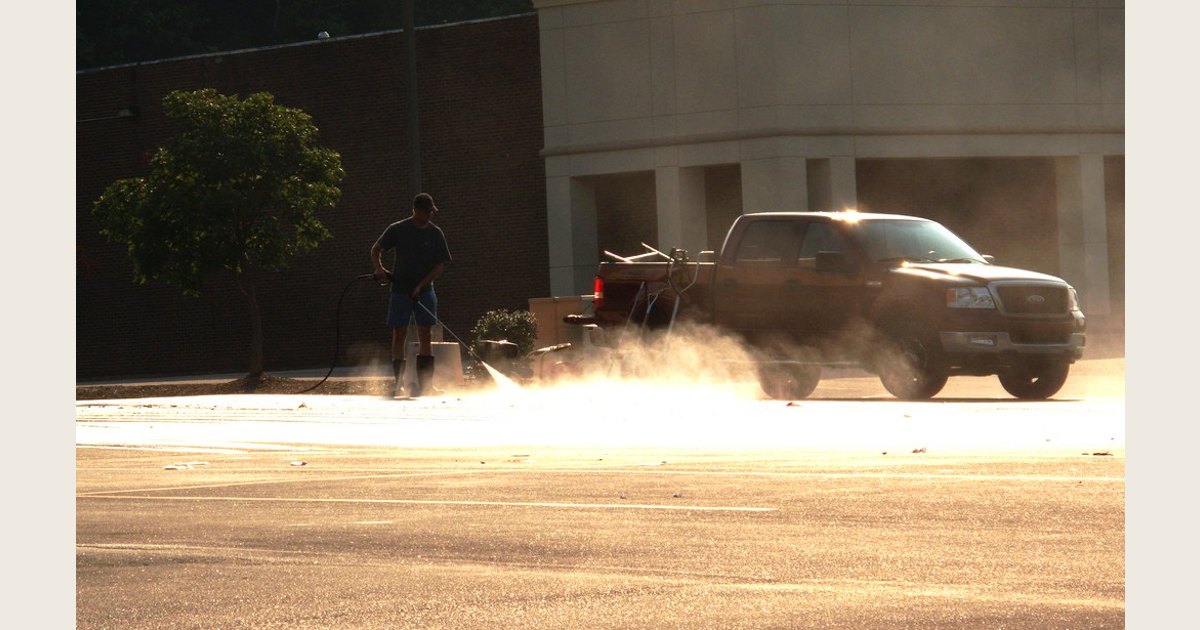
An example of the nozzle’s visible spray at the surface; the pump and unloader are upstream and out of view. Photo: “Pressure Washer” by urbanwoodchuck via Flickr, licensed under CC BY 2.0. Resized and padded; illustrative stock photo, no product testing is implied.
What a pressure washer can—and cannot—do
A pressure washer improves the delivery of water; it does not make every cleaning problem the same. A stream can dislodge loose dirt and rinse it away, while other deposits may call for a suitable cleaning method beyond water alone. Check the owner’s manual before using an optional cleaning solution or accessory.
The pump’s design also sets boundaries. Cat Pumps notes that pump flow is related to its speed and that downstream restrictions affect pressure. That means a different nozzle may change the operating conditions, but it does not increase the pump’s rated capacity. If pressure is unexpectedly high, low, or unstable, don’t turn an unloader adjustment into a guesswork fix. The symptom can involve the water supply, nozzle, gun, pump, or controls, and the correct checks are model-specific.
A practical way to understand an unfamiliar washer is to trace the path in order: confirm that the supply reaches the inlet; identify the pump and pressure hose; find the trigger gun and nozzle; then locate the unloader or follow the plumbing diagram in the manual. If a part leaks, the machine will not unload normally, or pressure behavior is abnormal, stop and use the manufacturer’s troubleshooting instructions or an authorized service provider. This guide explains the operating principle, not pressure-system repair.
Common questions
Does the pump make pressure, or does the nozzle?
The pump moves water, and the nozzle’s restriction helps create discharge pressure in the system. They work together: the pump supplies flow and the nozzle shapes and restricts it. Pressure depends on the complete washer setup, so a tip should match the manufacturer’s specifications.
What happens when I let go of the trigger?
The gun closes the outlet. In the pressure-sensitive unloader arrangement described by Cat Pumps, pressure between the gun and unloader shifts an internal valve or piston, allowing the pump to unload at low pressure. The exact arrangement on your machine may differ, so check its owner’s manual for normal trigger-off behavior.
Why is the spray weak or uneven?
The cause could be anywhere along the water path, including the supply, pump, hose, gun, or nozzle. Check only the user-level items covered by your manual, such as whether the supply and approved nozzle are correct. If the problem continues or involves a leak or pressure-control component, stop rather than opening or adjusting the pressure system yourself.
The short version
A pressure washer uses a motor or engine to drive a pump, which moves water through a hose and trigger gun to a nozzle. The nozzle shapes the spray and contributes to system pressure; the unloader responds when the gun closes. Choose settings and accessories to suit the machine and surface, not a single headline rating. For setup steps, see how to use a pressure washer; for cold-weather storage, read how to winterize a pressure washer.