Short answer: air purifiers can be worth it when you have an airborne-particle problem in a room you use often and buy a unit sized to that room. They are less compelling when the real problem is moisture or an ongoing pollution source. One small appliance also cannot clean an entire home. A portable unit supplements reducing pollution at its source and bringing in clean outdoor air; it does not replace either. The EPA makes that distinction clearly in its home air-cleaner guidance.
The money question is not whether every household “needs” an air purifier. It is whether you will use the right machine in the right space long enough to justify its filters and electricity. Start with the pollutant you want to address. Then check the clean air delivery rate (CADR), room size, filter replacement needs, and any gas or odor claims.
At a glance
- A portable purifier can be a useful extra layer for particles in one regularly used room.
- Match its particle CADR to the room or area, then plan for filter replacements and a fan setting you can actually use.
- Do not expect it to fix moisture, mold, or an active pollution source; reduce the source and ventilate with clean outdoor air first.
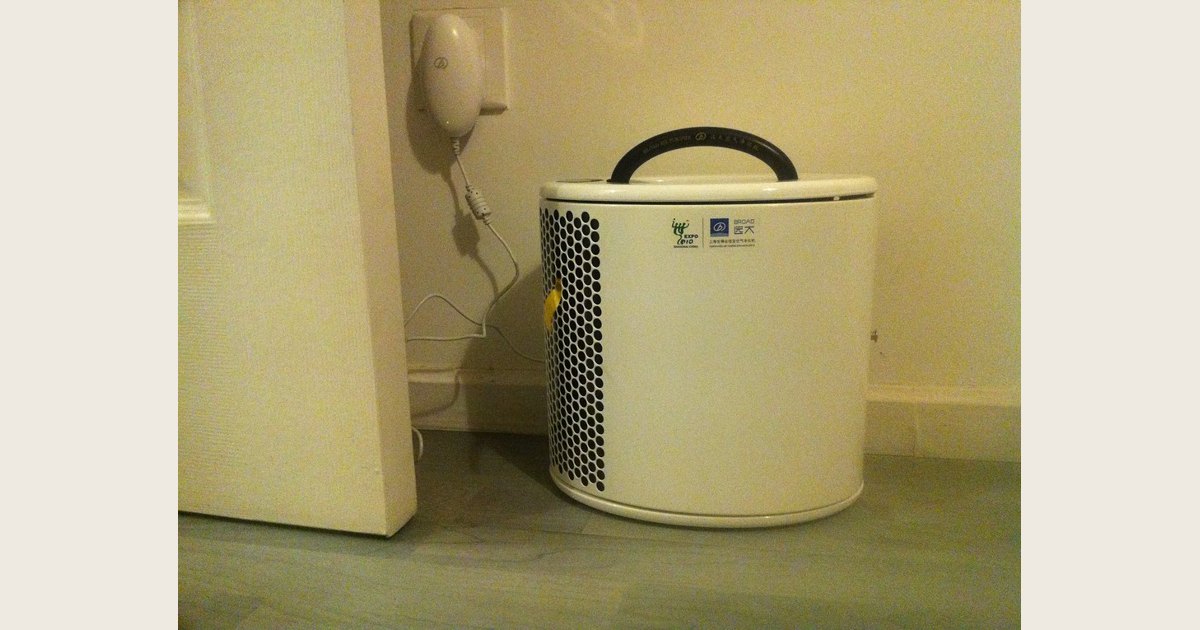
Featured image: White portable air purifier with a side grille on a hard floor.
Photo: Air Purifier by bfishadow, https://www.flickr.com/photos/61368956@N00/6471707209; https://creativecommons.org/licenses/by/2.0/. Resized and padded. Illustrative stock photo; no product testing is implied.
What a portable air purifier can—and cannot—do
EPA calls a portable air purifier a portable air cleaner; both terms mean a device designed for a single room or area. A purifier can reduce some indoor air pollution, especially particles, but it cannot remove every pollutant from the air. Central furnace or HVAC filters work differently: they filter air throughout the home only while the system is running. EPA’s overview explains the separate roles and shared limits of both approaches.
That makes a properly sized purifier a potentially useful tool for airborne particles in a bedroom, home office, or other frequently occupied room. The EPA’s consumer guide says some portable purifiers can filter fine particles of health concern, including PM2.5. It also says the health improvements seen in studies of portable HEPA purifiers tend to be small and may not be noticeable to an individual. Studies of allergy and asthma symptoms have also found possible improvements in some symptoms, rather than reliable improvement in every symptom. That is a useful reason to set practical expectations instead of treating a purifier as a medical solution.
The same distinction applies to odors and gases. Most filters are made for either particles or gases, not both. For gases, EPA recommends looking for activated carbon or another filter designed for gases; CADR is a particle rating, not a gas-removal rating. There is no widely used portable-purifier performance rating for gas removal, and activated carbon needs a substantial amount of material to be effective. EPA’s selection guidance has the details. For a deeper look at the odor question, read Do Air Purifiers Help With Smell? What They Remove (and What They Don’t).
| If this is your situation | A purifier may be worth it when… | Keep this limit in view |
|---|---|---|
| You want to reduce airborne particles in one regularly used room | The unit’s CADR suits the actual room or area, and you will run it regularly | One portable unit is not a whole-home answer |
| You are concerned about odors or gases | The unit has a gas-focused filter, such as activated carbon, and you check what the maker says it targets | CADR does not rate gas removal |
| You have allergy or asthma symptoms | It is one part of a plan and you keep expectations modest | Evidence does not show improvement in every symptom |
| You have a musty or moldy area | You first correct the water or moisture problem and clean up the mold | Filtration does not solve the cause of mold |
The purchase detail that matters most: room size and CADR
For particle removal, choose a portable air purifier with a CADR large enough for the space it will serve. CADR indicates how much particle-containing air a unit can clean. A higher CADR means more particle removal and a larger potential coverage area. Many packages list a maximum room size, but measure the space rather than relying on a vague description such as “large room.”
Measure length times width to get square footage. For an open plan, consider the whole connected area the purifier will realistically serve. EPA also advises selecting a larger unit if ceilings are higher than eight feet. Its sizing chart puts the minimum particle CADR at 195 cubic feet per minute for a 300-square-foot room with an eight-foot ceiling. Use the full EPA table and its room-measurement guidance when comparing labels.
For example, if you spend most evenings in a 300-square-foot bedroom or home office and want an extra particle-filtration layer there, compare the unit’s particle CADR with that room’s size. Do not assume the same unit will serve the rest of an open home. If the ceiling is higher than eight feet or the space opens into another room, size up instead.
When a package gives separate smoke, dust, and pollen CADRs, EPA identifies the smoke value with the smallest particles of the three. The ratings are typically measured at the highest speed. A machine that is adequate only at its loudest setting may filter less air on a quiet, lower setting. EPA notes that higher fan speeds and longer run times generally filter more air.
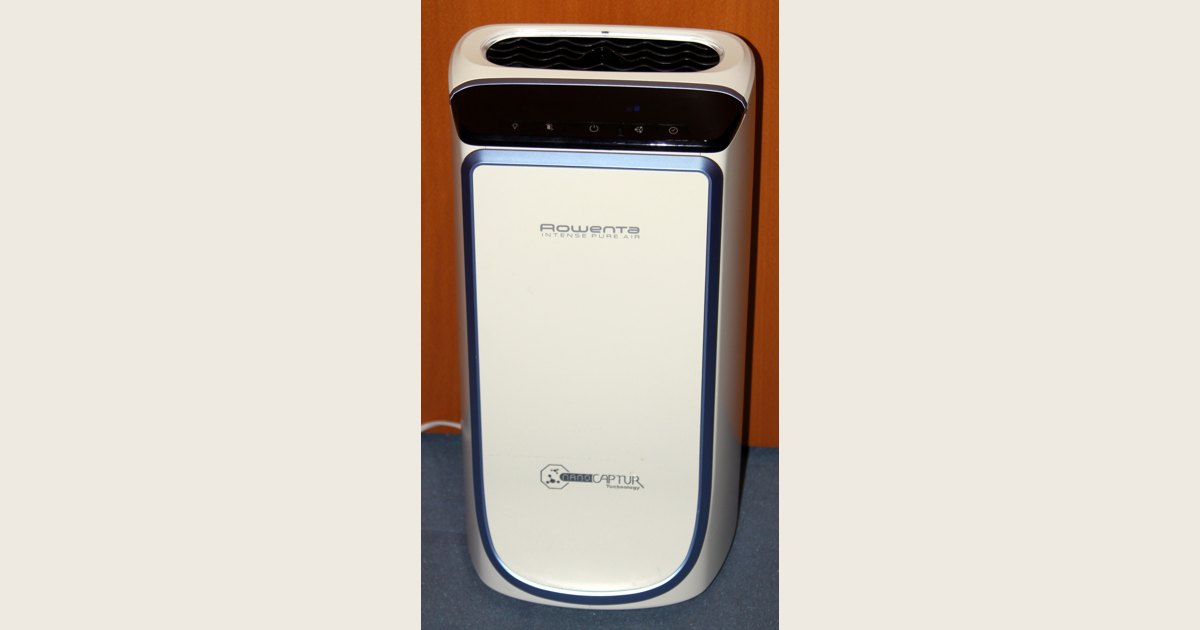
A portable purifier works room by room, so match its particle CADR to the size of the space it will serve.
Photo: Rowenta Intense Pure Air air purifier by Morn, https://commons.wikimedia.org/w/index.php?curid=108202463; https://creativecommons.org/publicdomain/zero/1.0/deed.en/. Resized and padded. Illustrative stock photo; no product testing is implied.
Look beyond the sticker price
An air purifier is not a one-time purchase. Every filter needs regular replacement, and a dirty, overloaded filter does not work well. Start with the manufacturer’s replacement schedule, then make sure replacement filters are readily available before buying. If a model uses more than one filter, identify what each one does and whether they are replaced together or separately.
Also separate particle performance from gas claims. A portable purifier may achieve a high particle CADR by using a high-efficiency particulate air (HEPA) filter, according to EPA, but a particle-focused unit does not automatically deliver meaningful gas removal. If odors or volatile organic compounds are your main concern, prioritize clear information about the gas filter rather than assuming a HEPA label answers that need. EPA discusses this filter split, along with the limits of current gas-removal ratings.
Electricity is part of the ongoing cost as well. An ENERGY STAR label can help identify a unit that meets EPA energy-efficiency guidelines, but EPA emphasizes that the label does not measure air-cleaning effectiveness. Compare energy information and filter costs, then return to the CADR and room-size match. A low operating cost is only a good value if the unit can move enough air for your space.
Quick buying checklist
Before you buy, write down:
1. the room’s square footage and ceiling height;
2. the particle or gas problem you want to address;
3. the CADR or gas-filter information on the label; and
4. the expected replacement-filter schedule.This prevents a common mismatch: paying for attractive features while overlooking whether the unit is sized for the job.
What an air purifier should not be asked to fix
First, it cannot substitute for source control. Cooking, cleaning, secondhand smoke, furnishings, and building materials can all contribute pollutants indoors. Reducing or removing the source and ventilating with clean outdoor air are EPA’s most effective approaches; filtration is an added layer. See EPA’s explanation of that hierarchy.
Second, it cannot solve a mold problem. EPA says mold is caused by a water or moisture problem that lets it grow. A purifier may remove some mold-related particles or help reduce some odors, but fixing moisture and cleaning up the mold are what address the problem.
Third, avoid devices that intentionally produce ozone. EPA calls ozone a lung irritant and advises avoiding portable air purifiers and HVAC filters that intentionally generate it. Its dedicated guidance on ozone generators sold as air cleaners is worth reading before treating ozone as a normal feature in an occupied room.
Use it in a way that makes the purchase count
Once you have a suitable model, keep the setup simple:
- Put it in the room where you spend the most time or where the particle concern is greatest.
- Keep the airflow clear. EPA advises keeping portable air purifiers away from curtains and other obstructions that can block airflow.
- Use a fan setting and run time that fit the problem. Higher speeds and longer operation generally mean more air passes through the filter, though noise can make a setting impractical for daily use.
- Replace filters on schedule, or sooner if they are heavily soiled. Do not wait for a neglected filter to become a performance problem.
- Reassess the room, not just the appliance. If a moisture source, a strong odor source, or poor ventilation remains, address that issue directly.
These are not glamorous steps, but they determine whether a portable purifier is doing meaningful work or simply taking up floor space.
So, are air purifiers worth it?
They are often worth considering when your goal is to reduce airborne particles in a particular occupied room. Choose a CADR that matches that space, and be ready for ongoing filter changes. Purifiers are easy to overvalue when the problem is something filtration cannot solve, such as a moisture problem. Broad “air cleaning” language is also not a substitute for checking particle and gas details.
The best value is usually targeted: identify the room and the pollutant, choose a machine you can use at a practical setting, and budget for replacement filters. If those pieces do not line up, skip the impulse purchase. Focus first on the pollutant source and ventilation.
Frequently asked questions
Is a HEPA label enough to choose an air purifier?
No. HEPA filters are often part of high-CADR particle cleaners, but the EPA recommends choosing a CADR that is large enough for the room. A HEPA reference does not replace checking the unit’s capacity, the room size, and whether you also need gas filtration. EPA’s consumer guide explains the distinction.
Can an air purifier replace ventilation?
No. EPA treats reducing pollution sources and ventilating with clean outdoor air as primary strategies; filtration supplements them. A portable cleaner can be useful in that broader approach, but it does not remove the need to deal with a pollutant source. Read the EPA overview.
Will an air purifier definitely improve allergy or asthma symptoms?
No. EPA says studies have found possible improvements in one or more symptoms, but not always major improvements and not in every symptom. Consider it one supportive indoor-air step rather than a guaranteed health outcome. See the EPA’s evidence summary.