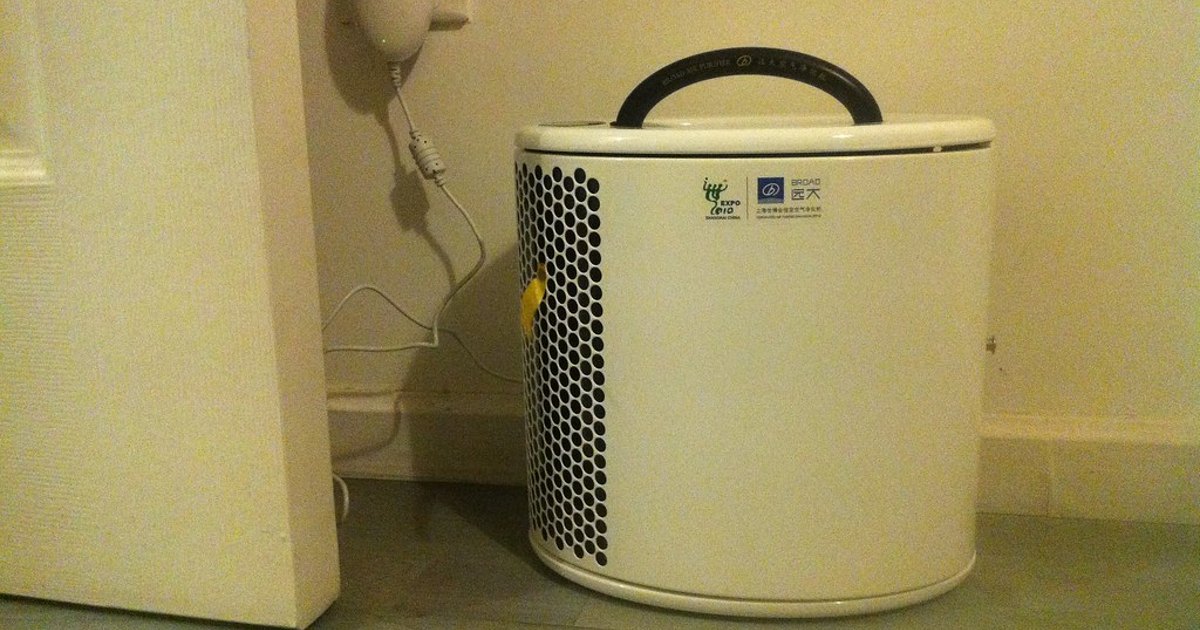
Yes — but only a certain kind of purifier, and only for certain smells. An air purifier reduces odors when it holds a meaningful amount of activated carbon or another sorbent filter designed for gases. A HEPA filter alone captures particles and does almost nothing for the gas molecules your nose registers as “smell.” And no purifier fixes an odor whose source is still in your home producing more of it.
Key Takeaways
- Odors are gases. Particle filters (HEPA) don’t remove gases — you need activated carbon (EPA).
- The amount of carbon is the variable that matters. EPA says carbon filters work “provided that there is a large amount of material used in the filter.”
- CADR ratings don’t measure odor removal. The CADR system is for particles only.
- Musty, sewer, or smoke-damage smells need source repair, not filtration.
- Skip anything that intentionally produces ozone. No federal agency has approved ozone generators for use in occupied spaces.
Why smell is a different problem than dust
Almost everything a purifier is marketed on — allergens, dust, pollen, smoke particles — is a particle. Odors are not. They’re volatile organic compounds and other gases small enough to slip through a HEPA filter’s fibers. As EPA’s Guide to Air Cleaners in the Home puts it, “most filters are designed to filter either particles or gases” — not both. To capture gases you need sorption: a material with enormous internal surface area that gas molecules stick to as air passes through — in home purifiers, almost always activated carbon. EPA is blunt about the tradeoff — there are “no widely used performance rating systems” for gas-removal filters, so you’re buying on materials, not a verified number.
Which smells a purifier actually helps with
The verdicts below are reasoned judgments built on EPA’s particle-versus-gas distinction and its source-control guidance, not measured test results.
| Smell | Will a carbon purifier help? | What actually fixes it |
|---|---|---|
| Cooking (fried food, fish, garlic) | Yes — noticeably | Range hood vented outdoors |
| Everyday pet odor in the air | Yes — partial, ongoing | Litter hygiene, washing bedding, grooming |
| Secondhand cigarette or cannabis smoke | Partial — airborne odor only | No indoor smoking; washing walls and fabrics |
| Wildfire smoke indoors | Particles yes, smell only with carbon | Closed windows, high fan speed, MERV 13+ filter |
| New furniture, paint, off-gassing | Partial and slow | Ventilation while curing; time |
| Musty, damp, “basement” smell | No — masks at best | Fixing the moisture source |
| Sewer or rotten-egg gas smell | No | Plumbing repair; for gas odor, leave and call the utility |
| Trash, litter box, spoiled food | No, while the source remains | Remove the source |
| Smoke damage after a fire | No | Professional restoration |
The pattern is simple: purifiers handle odors already dispersed in the air, and lose to any source that keeps emitting. EPA lists three basic strategies — source control, improved ventilation, and air cleaners — and says “usually the most effective way to improve indoor air quality is to eliminate individual sources of pollution or to reduce their emissions.” Filtration is third on that list for a reason.
The buying variable nobody puts on the box: carbon weight
Two purifiers can both say “activated carbon filter” and hold wildly different amounts of it: a scattering of carbon on thin fabric mesh in one, a deep bed of granular carbon in the other. The thin one fades sooner, because sorbent filters don’t clog like particle filters — they saturate. Once the carbon’s surface area is occupied, air passes through untreated, and no visible dirt warns you. EPA’s guidance points the same direction twice: carbon filters “can be effective, provided that there is a large amount of material used in the filter,” and for VOC removal, “the thicker the better.”
So compare these between models:
- Stated carbon weight in pounds or grams. If a manufacturer publishes it, that’s a good sign. If no one will tell you, assume it’s small.
- Filter depth. A carbon stage measured in fractions of an inch is a deodorizing gesture. A deep granular bed is a real gas filter.
- Granular or pelletized carbon over coated mesh. Loose granules mean more material and more contact.
- Replacement filter price. Carbon is consumable. If replacements cost nearly as much as the unit, factor that in.
- Run time and fan speed. EPA notes that “higher fan speeds and longer run times will increase the amount of air filtered.”
Sizing: use CADR for particles, common sense for odor
CADR (clean air delivery rate) is the one honest number in this category, and it only covers particles. The AHAM Verifide seal lists three CADR figures — tobacco smoke, pollen, and dust — all particulate. None describes odor removal. Sizing still matters indirectly: a unit too small for the room can’t move enough air through its carbon to keep up.
- AHAM’s 2/3 rule. Choose a unit whose tobacco smoke CADR is at least two-thirds of the room’s floor area in square feet. A 120 sq ft room needs a smoke CADR of at least 80. For ceilings higher than 8 feet, AHAM says to choose a unit rated for a larger room.
- EPA’s minimum CADR table. For 8-foot ceilings, EPA suggests roughly 65 cfm for 100 sq ft, 130 for 200, 195 for 300, 260 for 400, 325 for 500, and 390 for 600 sq ft. Measure length times width, size up for higher ceilings, and use more than one unit for large open spaces.
Two cautions: CADR is measured at the air cleaner’s highest speed, which is also its loudest, so if you’ll only run it on low at night the box number doesn’t describe your situation. And ignore ENERGY STAR as an air-quality signal — EPA states the label “does not refer to its air-cleaning effectiveness in any way.”
For wildfire smoke, EPA’s Wildfires and Indoor Air Quality page gives no special CADR formula — size the unit for the room, place it where people spend the most time, run it on the highest fan speed, keep windows closed, set central HVAC to recirculate with a MERV 13 filter, and make sure the unit doesn’t produce ozone. EPA describes smoke as a mixture of gases and fine particles, with the fine particles posing the biggest health threat — which is why a particle filter clears the haze while the smell hangs on.
When you don’t need to buy one
Run through this before spending anything:
- Can you smell it more strongly in one spot? Then it has a source. Find it. A purifier only dilutes the evidence.
- Does it appear only during or after an activity? Cooking, showering, painting. Exhaust ventilation is the right tool — EPA’s Improving Indoor Air Quality guidance says local bathroom or kitchen fans that exhaust outdoors “remove contaminants directly from the room where the fan is located and also increase the outdoor air ventilation rate.”
- Is it damp, earthy, or musty? A moisture problem. EPA’s brief guide to mold and moisture says you may suspect hidden mold “if a building smells moldy, but you cannot see the source,” and that “the key to mold control is moisture control.” Keep humidity below 60 percent, ideally 30 to 50. Clean mold up without fixing the water and it comes back.
- Is it a stored product? EPA notes indoor VOC levels run up to ten times higher than outdoors, with sources including air fresheners and moth repellents, and that “gases can leak even from closed containers.” Moving paint or solvents to a detached garage is free.
- Can you open a window? On a mild, low-pollen day, ventilation clears most transient odors faster than any appliance.
Buy a carbon purifier when the odor is chronic, diffuse, and you’ve already dealt with the source — pet households, or apartments with cooking or smoke drifting in from neighbors.
Maintenance, or why an old purifier can smell worse
Filters are consumables, and a neglected purifier becomes part of the problem. EPA is direct: “All filters need regular replacement. If a filter is dirty and overloaded, it won’t work well.” Intervals vary too much between models to generalize — follow your unit’s manual. For scale, EPA notes that furnace and HVAC filter makers typically recommend replacement every 60 to 90 days, and that during heavy wildfire smoke you may need to replace filters more often than the manufacturer suggests. Two signs it’s time: the unit stops making a difference you can smell, or it develops a stale odor at startup. Washing carbon doesn’t restore it — once saturated, it’s done.
Skip ozone generators, and be skeptical of “filterless” tech
This is the one place where the wrong purchase can make your air worse. EPA’s page on ozone generators sold as air cleaners states that “NO agency of the federal government has approved these devices for use in occupied spaces,” and that when inhaled, “ozone can damage the lungs,” with relatively low amounts causing chest pain, coughing, shortness of breath, and throat irritation.
On odor specifically: at concentrations that don’t exceed public health standards, ozone “has little potential to remove indoor air contaminants,” and “body odor may be masked by the smell of ozone but is not removed by ozone.” In one new-carpet experiment, organic chemical concentrations in the air went up rather than down after ozone was introduced.
Some devices emit ozone as a byproduct rather than by design — EPA names electrostatic precipitators, ionizers, uncoated UV lamps, and plasma devices, and notes that the California Air Resources Board and AHAM both list air cleaners tested and shown to emit little or no ozone. As for photocatalytic oxidation, plasma, and UV sold as odor solutions, EPA says research “has not yet shown” they “can remove gases effectively in portable residential air cleaners.”
Smells that mean stop, not shop
A few household odors are safety signals, not nuisances:
- Rotten eggs or sulfur near gas appliances. Leave the building, then call your gas utility or 911 from outside.
- Sewer gas. Often a dry trap or a venting fault; a plumber, not a purifier.
- Persistent musty smell with visible staining. A moisture and mold problem. EPA considers under roughly 10 square feet DIY-scale; larger areas warrant professional help.
- No smell at all. Carbon monoxide is odorless, colorless and toxic, and EPA warns that CO can kill before you know it’s in your home. EPA relays the Consumer Product Safety Commission’s recommendation that every home have CO alarms on each level, outside each sleeping area. Watch for headaches, dizziness, confusion, nausea, and flu-like symptoms that ease after you leave the house. If you suspect CO, EPA says to get fresh air immediately — open doors and windows, turn off combustion appliances, leave the house — then go to an emergency room and say you suspect CO poisoning. Call 911 if anyone is badly affected.
Still smells? Work the list in order
- Hunt the source room by room, then cabinet by cabinet: under sinks, behind appliances, the fridge drain pan, the litter area.
- Fix or remove what you find. Clean hard surfaces with detergent and water and dry completely; porous items that stay smelly often have to go.
- Ventilate — exhaust fans during odor-producing activities, windows when outdoor air allows.
- Control humidity to 30–50 percent if anything smells damp.
- Only then add a purifier with real carbon mass, sized for the room, with filters replaced on schedule.
If you’ve done all five and the smell persists, it’s probably structural — a leak, a failed seal, contaminated insulation — and that’s an inspection, not an appliance.
Photo: “Air Purifier” by bfishadow, licensed under CC BY 2.0. Resized and cropped. Illustrative stock photo; no product testing is implied.